Balikan: Where Geometric Precision Meets Arabic Calligraphy
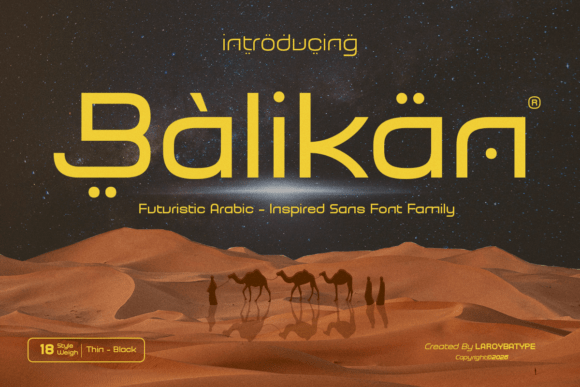
There’s a certain tension in design that makes a project feel alive—where cultural heritage collides with futuristic minimalism. You see it in architecture that nods to history while pushing into tomorrow, and you feel it in typefaces that refuse to be boxed into a single category. If you’ve been searching for a typeface that carries that same electric duality, Balikan might be the missing piece in your visual toolkit. It’s a sans serif font family that doesn’t just sit on the page; it starts a conversation, blending the clean, mathematical lines of modern geometry with the fluid, elegant nuances of Arabic calligraphy.
At its core, Balikan is a premium font designed for creators who want their work to feel both contemporary and culturally rich. It’s not about slapping an Arabic-inspired filter on standard Latin characters. Instead, the designer has woven subtle calligraphic details—smooth curves, tapered strokes, and rhythmic flow—into a highly legible, forward-looking sans-serif structure. This makes it a fascinating choice for anyone building a brand identity that needs to feel global, sophisticated, and unmistakably modern. Whether you’re a small business owner crafting packaging for a luxury product, a marketer developing a campaign for a tech startup, or a designer working on editorial layouts, this typeface offers a visual personality that’s hard to ignore.
A Typeface with a Dual Identity: Modern Utility and Cultural Depth
What sets Balikan apart from many other display fonts or creative fonts is its ability to bridge two worlds without sacrificing readability. Some decorative typefaces prioritize style over function, becoming nearly impossible to read in smaller sizes or dense text blocks. Balikan avoids that trap. Its clean sans-serif foundation ensures that it works beautifully for semi-body text in digital interfaces, blog headers, or even longer print paragraphs. Yet, its distinct character—the way a letter might curve with a whisper of Naskh or Thuluth script influence—gives it an artistic flair that’s perfect for logos, film titles, or social media graphics where you need to make an immediate impact.
Think about the brands that resonate with you. Often, their visual identity tells a story beyond the product itself. Balikan allows you to embed a narrative of innovation and cultural appreciation directly into your typography. For a tech company looking to signal both cutting-edge progress and a connection to a broader, global audience, this font can be a powerful tool. For a boutique hotel or a high-end cosmetics brand, it can evoke a sense of luxury and exotic elegance. The key is that it does this authentically, through its design DNA, rather than through clichéd stereotypes.
Practical Applications: From Branding to Digital Interfaces
Let’s move beyond theory. Where and how can you actually use Balikan? The versatility of this font family is one of its strongest assets. It’s not a one-trick pony reserved for a single type of project. Here’s a breakdown of its potential applications, grounded in real-world design needs:
- Logo Design & Brand Identity: A logo set in Balikan immediately communicates a modern, premium brand. Its unique structure ensures your mark won’t get lost in a sea of generic sans serifs. For businesses in the Middle East, or those aiming for an international market, it can serve as a subtle bridge between cultures.
- Packaging Design: On a shelf or in an online store, packaging needs to tell its story in seconds. Balikan’s strong visual personality makes product names and key information pop. It’s particularly effective for luxury goods, artisanal products, or tech accessories where design is part of the value proposition.
- Editorial & Print Layouts: Magazines, lookbooks, and annual reports often use a mix of fonts for hierarchy. Balikan can serve as a stunning headline font, drawing readers into a feature story, while a more neutral body font handles the paragraphs. Its readability in larger blocks also makes it suitable for pull quotes or subheadings in longer documents.
- Web & UI Design: In digital spaces, clarity is king. Balikan’s geometric precision translates well to screens, maintaining its character even at smaller sizes. It can be used for website headers, button text, or app interfaces to create a distinct user experience that feels polished and intentional.
- Social Media & Marketing Assets: Instagram graphics, Facebook ads, and YouTube thumbnails thrive on bold, scroll-stopping typography. Balikan can help your content stand out in a crowded feed, giving your marketing materials a consistent and recognizable look that boosts brand recall.
- Physical Merchandise & Invitations: From tote bags and apparel to wedding invitations and event posters, this font adds a touch of artistic sophistication. Its fusion style makes it ideal for projects that aim to feel special, curated, and memorable.
The practical takeaway here is about visual consistency. When you use a distinctive yet versatile typeface like Balikan across multiple touchpoints—from your website to your business cards to your Instagram Stories—you build a cohesive brand identity. This consistency is what helps audiences recognize and remember you, which is a fundamental goal of good design and marketing.
Making It Work: Pairing, Licensing, and Readability
Adopting a new font, especially one with a strong personality, requires some thoughtful consideration. Here’s some practical advice for integrating Balikan into your workflow effectively.
First, think about font pairing. Balikan is a display-oriented sans serif, which means it often works best when paired with a more neutral, highly readable font for longer body text. Consider classic serif fonts like Garamond or modern, clean sans serifs like Helvetica Neue or Inter for paragraphs. The contrast will allow Balikan to shine in headlines and titles without overwhelming the reader. Always test your pairings in context—see how they look on a mockup of your website, a sample packaging layout, or a draft social media post.
Second, review the included font styles. A robust font family often comes with multiple weights—Light, Regular, Medium, Bold, etc.—and sometimes stylistic alternates. Explore these options. A lighter weight of Balikan might be perfect for elegant subheadings, while a bold weight could be your go-to for impactful call-to-action buttons. Understanding the full range of what’s available ensures you get the most out of your investment.
Third, never compromise on readability. While Balikan is designed for clarity, always consider the context. For very small text on a digital screen (like legal disclaimers), it might be safer to use a simpler, more utilitarian font. For print, ensure the size and weight you choose hold up well on the chosen paper stock. A quick print test or a digital prototype on different devices can save you from costly mistakes.
Finally, consider the licensing. If you’re using Balikan for a commercial project—whether it’s for a client, your own business, or a product for sale—ensure you have the appropriate commercial license. Most premium fonts require a license for commercial use, and respecting this supports the designers who create the tools we rely on. Check the license details for the specific uses you have in mind, such as for digital products, merchandise, or client work.
In the end, choosing a typeface like Balikan is about making a deliberate choice for your brand’s voice. It’s a design asset that offers more than just letters; it offers a mood, a story, and a point of differentiation. By applying it thoughtfully, with an eye for pairing, readability, and context, you can leverage its unique fusion of aesthetics to create work that feels both professional and deeply resonant.